Technique · November 13, 2026 · 4 min read
Is the hook a viable technique?
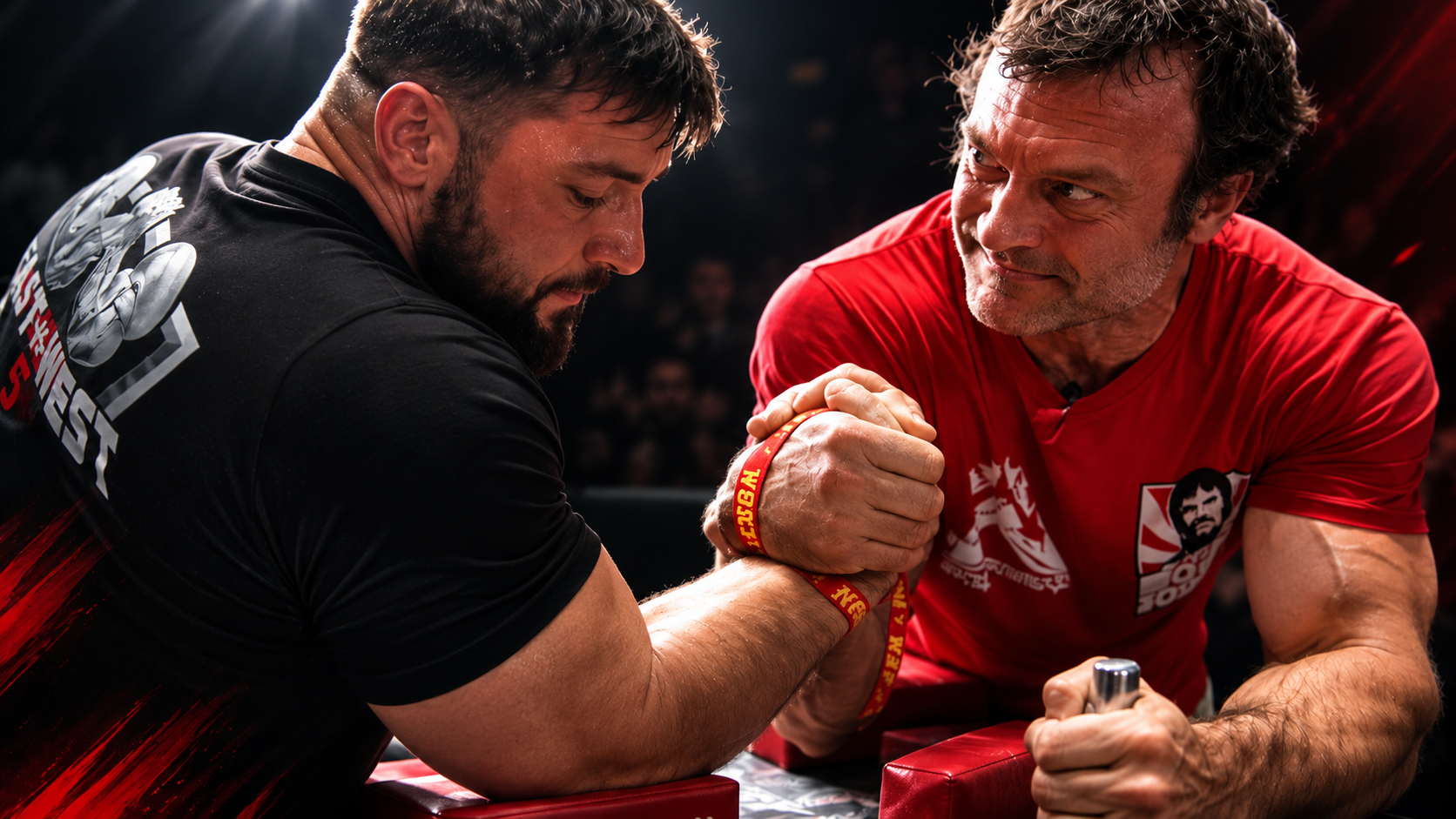
If you have been following the sport of armwrestling over the the last several years, a trend you may have noticed is the absence of the hook only pullers in the top 10 super-heavyweight ranking. Every single person officially ranked has either been predominately a toproller, or a flop wrist presser. Of course there are plenty of armwrestlers in the top 10 who have a hook as an option, but no one who essentially uses a hook as there only strategy. On the other hand, we do have several armwrestlers who pretty much only toproll. Ermes Gasparini, Georgi Tsvetkov, Vitaly Laletin, and Levan Saginasvhili are all good expamples of armwrestlers you never see opening a match in a toproll out of their own free will. So what is the reason for this?
My personal belief is that hooking is simply less efficient than toprolling. In other words, for the average person, if they could clone themself at birth, and one clone trains hooking for the rest of his life, and the other clone trains toprolling for the rest of his life, if they were to armwrestle one another, the toproller will win the vast majority of the time. Of course there are many other factors to it than this. Certain pullers come to mind that have a genetic predisposition toward being very strong at bending their wrist, such as Artur Makarov. But in general, most people will be better off making the toproll their go to move.
This is primarily because hook pullers are at a mechanical disadvantage. If you are a hook puller, the lynchpin of your entire style will be whether or not you can bend your wrist. You can become very strong at this, but at the end of the day, you are putting your wrist flexor up against someone's lat, bicep, and pronator muscles. The toproller gets to combine multiple muscles together, some of which are very large muscles, and you only get to use your forearm. This is just a losing battle. This is exactly what Devon Larratt is talking about when he says "don't hold onto your opponent."
One could argue that the hook puller doesn't rely on only one muscle, since he can also implement supination. This is true for some matches, but I think ultimately the toproller can mitigate this via wrist extension. If you are a hook puller who relies on supinate, and you go against a top roller who is willing to slightly kick his wrist back, you know what this feels like. Most of the time toprollers will fall for the trap of supination. Afterall, you are "giving" them their cup for free. Why wouldn't they take it? As the seasoned toproller knows, cupping against a good hook puller normally just makes things worse. By cupping you are giving your opponent supination, which gives them a stronger connection to their arm. After supination takes place, the act of hitting sideways will put far less pressure on the hook pullers wrist flexion. But as stated earlier, once this information is discovered by the toproller, he simply needs to stop falling for the trap, and implement wrist extension.
Another point could be made that the hook puller, given an ideal setup, can actually shoot his arm forward, and chop down onto the opponents pronator. In this situation, the hook puller is able to use his entire body to attack his opponents pronation. This is definitely a significant advantage! However, once again, technique can mitigate this advantage. If the toproller knows how to setup, he can legally set up in a way that makes this technique very watered down for the hook puller.
Another interesting part of this puzzle, is that the high percentage of toprollers seems to be primarily in the super-heavyweight category. People have posited many ideas to explain this. Perhaps the bigger average hand size of super-heavyweight pullers applies more torque to the wrist. Perhaps the extra muscles you can use in a top roll such as the lat, are simply heavier than the wrist flexor, so it makes to see more outside pullers in the super-heavyweight category. Whatever the reason, that is a very interesting wrinkle. However, many of the super heavyweight pullers would be quite comfortable cutting down to the 115kg category, and perhaps even beyond that. Devon Larratt vs Evgeny Prudnik, or Ivan Matyushenko, paints a pretty clear picture of the best hook pullers vs the best toprollers of that category.
Another possible option is randomness. Perhaps we just find ourselves in an era of the sport where toprollers are everywhere, but this will not always be the case. Maybe 10 years from now, everyone will be a hook puller. This is possible, but I find it unlikely. Elite competition, especially when paid tends to bring out the very best in the world. I think this kind of situation would be more likely 50 years ago. But in 2026, I think that we are getting pretty close to the pointy end of armwrestling potential.
In the end, I believe that at least in the super heavyweight category, toprolling is the best option as a leading weapon. However, this does not mean that hooking is not still super valuable as backup move, or a midmatch technique. Although the vast majority of the 10 top super-heavyweight matches open in a toproll, many of them finish somewhere else. I think that inside arm wrestling is a critical part of the sport, and is not going away any time soon.
Please let me know what you think about this topic in the comments below! I would love to hear any additional possible explanations of the data!
Comments (0)
Loading comments…